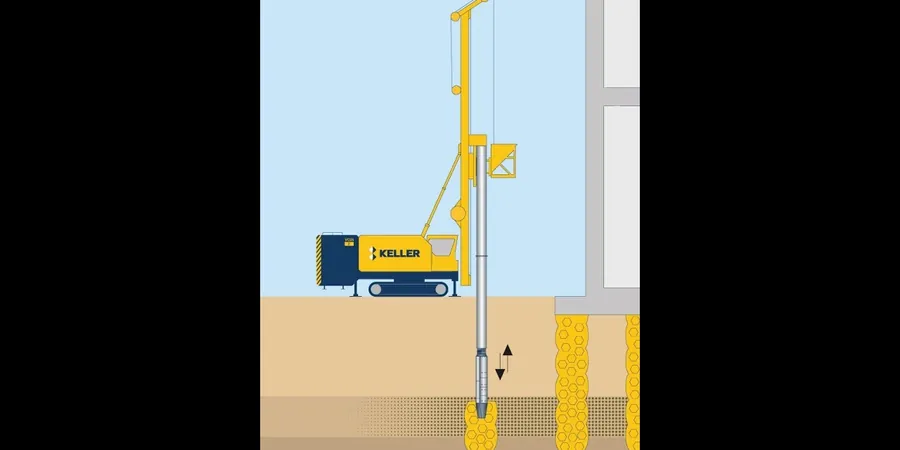
Eugene sits on a deep basin of Willamette River sediments, where loose silty sands and gravels dominate the subsurface. That granular profile, shaped by millennia of flooding, is exactly the type of soil that vibrocompaction can densify effectively. A CPT test run across a site near Delta Highway recently mapped sand lenses with relative density below 40 percent, a classic target for this ground improvement method. Vibrocompaction design in Eugene must account for seasonal groundwater perched barely five feet down in the wet months. The engineering challenge is predictable: post-compaction verification testing confirms that clean sands densify well, but silty zones require tighter spacing and longer probe time. We tailor each array to the grain-size curve and fines content from the borings, not a generic catalog.
A well-designed vibrocompaction grid can take a loose alluvial sand from 40 percent to over 75 percent relative density in a single pass.