GEOTECHNICAL ENGINEERING
EUGENE OREGON
HomeGround improvementStone column design

Stone Column Design in Eugene, Oregon | Ground Improvement & Load-Bearing Solutions

Geotechnical engineering with regional judgment.

LEARN MORE

Eugene sits at an elevation of roughly 430 feet, where the Willamette River has spent millennia depositing layers of soft alluvium and silty clays across the valley floor. For structural engineers working in the city's downtown core or near the river, these subsurface conditions create a direct challenge: how to support significant column loads without driving deep foundations through 30-plus feet of compressible material. Stone column design offers a technically sound alternative that improves bearing capacity while accelerating consolidation in the native silts that dominate Eugene's geology. The approach has proven particularly effective in the Whiteaker and River Road areas, where high seasonal groundwater limits the feasibility of over-excavation. When the granular fill is properly graded and the installation follows vibro-replacement procedures verified against ASTM D2487 classifications, the composite ground mass can achieve bearing pressures exceeding 6 ksf. For projects requiring a detailed stratigraphic profile before column design, our team coordinates with SPT drilling to map refusal depths and identify any buried organics.

A properly designed stone column grid in Eugene's silts can cut post-construction settlement by half compared to untreated ground, while providing a verifiable drainage path for excess pore pressure.
Our service areas

Scope of work

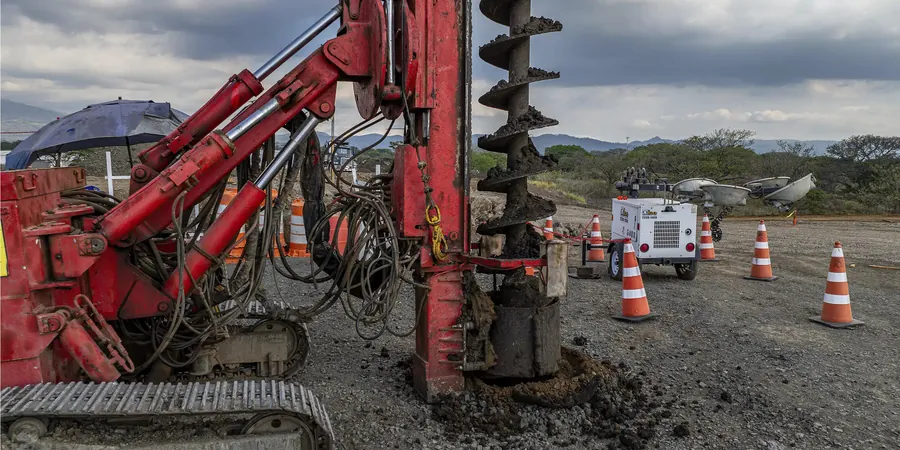
A recent multi-story mixed-use project on Willamette Street required bearing pressures that the native lean clay could not sustain without excessive settlement. The design team proposed a grid of stone columns extending to 28 feet, where the standard penetration resistance finally exceeded N=15. Vibro-replacement equipment was mobilized with a 130-ton crawler crane, and the stone backfill was a clean, angular basalt meeting Oregon DOT's Class 2 permeable aggregate spec. Real-time ammeter readings confirmed column diameters of 36 to 42 inches throughout the treatment zone. One notable characteristic of Eugene's subsurface is the presence of discontinuous silt seams that can pinch out laterally; this variability demands a site-specific approach rather than a uniform grid. We correlate the column spacing with the results from CPT testing to refine the area replacement ratio and verify that the composite shear strength meets the project's factor of safety under the ASCE 7-22 load combinations. Post-installation modulus values typically fall between 250 and 400 ksf, depending on the confinement provided by the surrounding matrix.
Stone Column Design in Eugene, Oregon | Ground Improvement & Load-Bearing Solutions
Technical reference — Eugene Oregon

Area-specific notes

Geotechnical conditions shift dramatically between the older, higher terraces south of 18th Avenue and the floodplain soils north of the B&O Railroad tracks. The south-side sediments contain more overconsolidated clay with gravel lenses, where stone columns serve mainly as settlement reducers. North of the tracks, however, the profile is dominated by normally consolidated silts with interbedded peat layers; here, the columns must also function as a liquefaction mitigation measure for the seismic demand associated with a M9.0 Cascadia event. The biggest risk we encounter in Eugene is underestimating the smear effect during vibro-replacement in sensitive silts, which can temporarily reduce the horizontal permeability and delay pore-pressure dissipation. A pre-production test section with pore-pressure transducers becomes essential. Another failure mode emerges when the column length is terminated short of a competent bearing stratum, leaving the entire improved mass to punch into the underlying weak layer. Every design we deliver includes a verification of the end-bearing condition via a minimum of two CPT soundings within the treatment footprint.

Need a geotechnical assessment?

Reply within 24h.

Email: contact@geotechnical-engineering.vip

Standards used

ASTM D2487 (Soil Classification), ASCE 7-22 (Minimum Design Loads), IBC 2024 Chapter 18 (Soils and Foundations), FHWA-NHI-16-027 (Ground Improvement), ASTM D5778 (CPT Procedures)

Technical parameters

ParameterTypical value
Typical treatment depth in Eugene Valley fill15 to 35 ft
Achievable composite friction angle38° to 44°
Post-treatment bearing pressure range4,000 to 8,000 psf
Stone column diameter (vibro-replacement)30 to 46 in
Typical area replacement ratio10 to 35%
Backfill gradation (ASTM D448)No. 57 to No. 4 stone
Settlement reduction factor2 to 4

Common questions

What is the typical cost range for a stone column design package in Eugene?

For a typical commercial lot in Eugene requiring treatment of 2,000 to 8,000 square feet, the design package, including subsurface review, column layout optimization, and construction specifications, generally falls between US$1,490 and US$5,470. The final fee depends on the number of CPT soundings needed and whether a 3D finite-element settlement analysis is required by the geotechnical reviewer.

How does stone column installation affect adjacent structures in a dense area like downtown Eugene?

Vibro-replacement generates lateral vibrations that can be perceptible within 50 to 75 feet of the probe. We establish pre-construction condition surveys and vibration monitoring thresholds—typically 0.5 in/sec peak particle velocity for unreinforced masonry buildings common in Eugene's older commercial blocks. In sensitive settings, we may recommend a pre-augered lead hole to reduce the radial displacement and keep the vibration envelope within acceptable limits.

Can stone columns replace deep foundations entirely for a mid-rise building on Eugene's riverbank soils?

In many cases, yes. When the design bearing stratum is within 35 feet of grade and the untreated soil has a minimum undrained shear strength above 300 psf, a stone column grid can often eliminate the need for driven piles or drilled shafts. The key is demonstrating that the composite ground mass meets the allowable settlement and bearing capacity under the IBC Chapter 18 requirements, which we validate through a pre- and post-treatment CPT program across the column grid.

Location and service area

We serve projects across Eugene Oregon and its metropolitan area.

View larger map