GEOTECHNICAL ENGINEERING
EUGENE OREGON
HomeLaboratoryLaboratory CBR test

Laboratory CBR Testing for Pavement Design in Eugene Oregon

Geotechnical engineering with regional judgment.

LEARN MORE

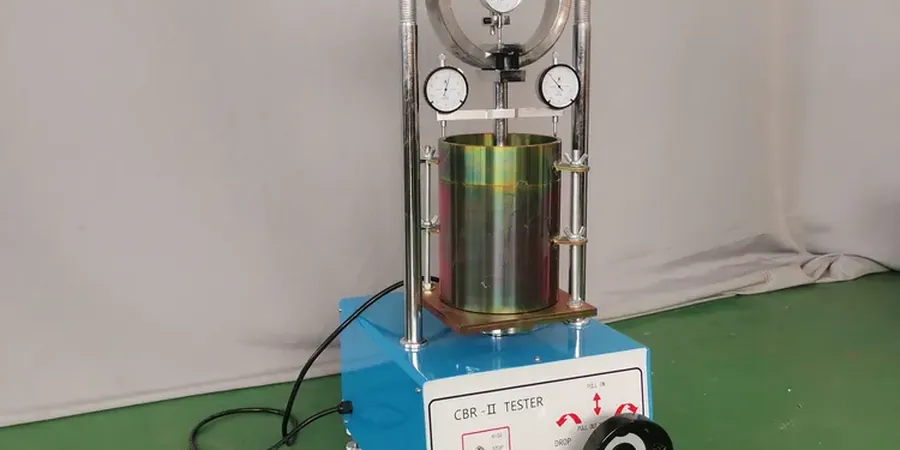
Designing a pavement section off Coburg Road near the Willamette River floodplain presents a completely different subgrade challenge than a subdivision up in the South Hills on weathered volcanic residuum. The valley floor here in Eugene carries high-plasticity Willamette Silt — material that loses significant bearing capacity when saturated by our long rainy winters — while the hillside sites often hide stiff but highly variable clayey silts over basalt. A standard Proctor test confirms compaction targets for either scenario, but neither tells you how the compacted soil will actually support traffic loading through a wet season. That is exactly what the laboratory CBR test quantifies: a direct soaked-strength number that feeds directly into the AASHTO 93 pavement design equation. Our lab runs the test per ASTM D1883 on remolded samples compacted at the moisture and density the contractor is expected to achieve in the field; we then soak the specimens for 96 hours — replicating the worst-case saturated condition Eugene subgrades experience from November through April. For projects where the near-surface material varies sharply, we pair the CBR program with a test pit investigation to log the soil profile and select representative samples from each distinct layer before running the lab program.

Running a CBR test without the full 96-hour soak in the Willamette Valley is like designing a roof for Arizona and installing it in Oregon: the numbers won't survive the first real winter.
Our service areas

Scope of work

ASTM D1883 and AASHTO T-193 govern the soaked California Bearing Ratio procedure, and both standards are especially relevant here in Eugene because our Mediterranean climate — with essentially zero rainfall in August but nine inches in December — creates extreme seasonal moisture swings in the subgrade. A CBR value run on an unsoaked sample is optimistic fiction; we run the full 96-hour soak mandatory for pavement design. The test procedure starts with a standard or modified Proctor compaction curve on the project soil, then remolds three specimens at varying moisture contents bracketing optimum, applies a surcharge weight simulating the pavement structure above, and submerges them in water while monitoring swell daily. After soaking, a 3-square-inch piston penetrates each specimen at 0.05 inches per minute while we record load at standardized penetration depths. The final CBR number — reported at 0.1-inch and 0.2-inch penetration — is the ratio of the measured load to a standard crushed-stone reference. What many local designers overlook is that Willamette Silt can swell 2 to 4 percent during the soak phase, and that swell alone will destroy a thin asphalt section even if the CBR value looks adequate. For projects where we need to characterize variability across a large site, we also run grain-size analysis to correlate fines content with soaked CBR, giving the pavement designer a defensible basis for zoning the subgrade into design segments rather than overdesigning the whole project for the weakest spot.
Laboratory CBR Testing for Pavement Design in Eugene Oregon
Technical reference — Eugene Oregon

Area-specific notes

A pavement design built on an unsoaked CBR value from a Eugene project is a warranty claim waiting to happen — we have seen it repeatedly on commercial parking lots around Gateway that developed alligator cracking within three years of construction. The mechanism is straightforward: the soil compacts beautifully in August at 95 percent modified Proctor and yields a CBR of 12 or 14, so the designer calls out 4 inches of asphalt over 8 inches of aggregate base, and everyone walks away happy. Then the winter rains arrive, the water table rises into the subgrade in low-lying areas, the Willamette Silt saturates and loses sixty percent of its bearing strength, and suddenly that effective CBR is a 3 or 4 under trafficking. The pavement section that looked conservative on paper is now structurally deficient. Our lab specifically targets the saturated worst case because Eugene's average annual precipitation of 46 inches — and the perched groundwater that sits on the valley floor's clay lenses — makes saturation the design condition, not the exception. The cost of running the soaked test is trivial next to the cost of a full-depth pavement reconstruction five years after the grand opening.

Need a geotechnical assessment?

Reply within 24h.

Email: contact@geotechnical-engineering.vip

Standards used

ASTM D1883: Standard Test Method for California Bearing Ratio (CBR) of Laboratory-Compacted Soils, AASHTO T-193: Standard Method of Test for the California Bearing Ratio, AASHTO 93 Guide for Design of Pavement Structures

Technical parameters

ParameterTypical value
Standard followedASTM D1883 / AASHTO T-193
Sample preparationRemolded at target field density and moisture
Soaking period96 hours minimum, fully submerged
Swell monitoringDial gauge readings at 24, 48, 72, 96 hours
Penetration rate0.05 in/min (1.27 mm/min)
Surcharge weight10 lb minimum, simulating pavement mass
CBR reporting depths0.1 in and 0.2 in penetration
Specimens per soil typeThree, bracketing optimum moisture

Common questions

What does a laboratory CBR test cost in Eugene?

For an ASTM D1883 soaked CBR test on three remolded specimens — which is the standard count to bracket optimum moisture — the cost runs between US$140 and US$220 per soil type, depending on whether a Proctor compaction curve is already available or must be run as part of the program. A full subgrade characterization package that includes CBR, Atterberg limits, and grain-size analysis on two or three distinct soil units typically falls in proportion to the number of tests ordered.

Why is a soaked CBR test necessary for Eugene pavements instead of a field CBR test?

Field CBR tests give a snapshot of in-situ conditions on the day of testing, which in Eugene's dry summer months can be misleadingly optimistic. The laboratory soaked CBR per ASTM D1883 remolds the soil to the density and moisture the contractor will actually achieve, then submerges it for 96 hours to replicate the saturated condition the subgrade will experience during our rainy season — November through April — when the Willamette Silt loses significant bearing capacity. That worst-case number is what the AASHTO pavement design equation requires.

How many soil samples are needed for a representative CBR program?

The number depends on site variability. For a uniform Eugene valley-floor site underlain entirely by Willamette Silt, one set of three CBR specimens may suffice. For sites straddling the valley margin — for example near the base of Skinner Butte or along the McKenzie River terraces — the subgrade can transition from silt to sandy gravel to weathered basalt within a few hundred feet, and each distinct soil unit should have its own CBR determination. We typically recommend exploratory test pits or SPT borings first to map the soil profile, then select sampling intervals that capture each layer the pavement will bear on.

Location and service area

We serve projects across Eugene Oregon and its metropolitan area.

View larger map