GEOTECHNICAL ENGINEERING
EUGENE OREGON
HomeFoundationsShallow foundation design

Shallow Foundation Design in Eugene, OR — IBC & ASCE 7 Compliant Bearing Capacity

Geotechnical engineering with regional judgment.

LEARN MORE

Shallow foundation design in Eugene, Oregon must contend with a subsurface profile shaped by the Willamette River floodplain and the foothills of the Coast Range. The 2024 Oregon Structural Specialty Code, which adopts IBC 2024 with state amendments, ties allowable bearing pressure directly to site-specific investigation per ASCE 7-22 Chapter 20. Our laboratory performs the classification and strength testing that feeds into that analysis: grain-size distribution under ASTM D6913, Atterberg limits per ASTM D4318, and direct shear on undisturbed samples recovered from the silty clays and gravelly alluvium common along the McKenzie River corridor. When a project site lies within a mapped landslide zone — the city maintains a steep slope overlay district south of 30th Avenue — we pair our index testing with a slope stability assessment to verify that the bearing stratum will not be undermined by adjacent terrain movement. Every report includes a site-specific bearing capacity table calibrated to the minimum footing width required by ACI 318-19 Chapter 13, so the structural engineer receives parameters ready for direct input into their foundation model.

Bearing capacity in Eugene’s Willamette Silt is settlement-controlled, not strength-controlled — the 2,000 psf threshold emerges from consolidation behavior, not shear failure.
Our service areas

Scope of work

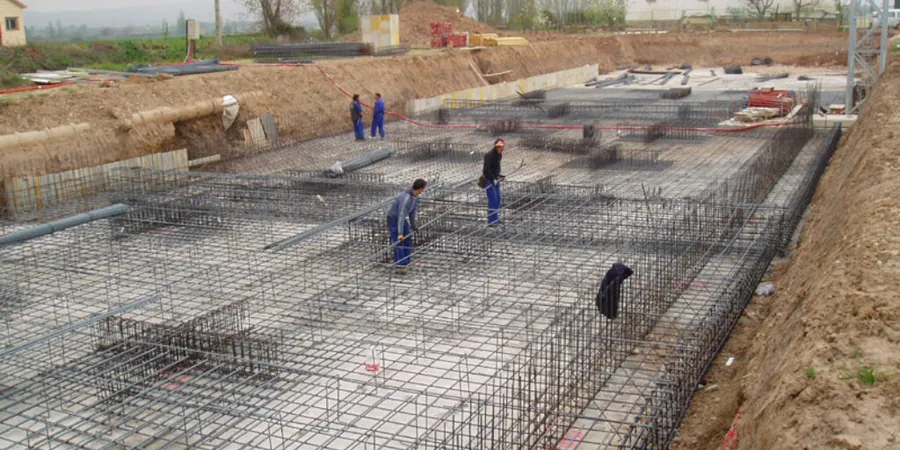
A recent project on a redeveloped lot off Franklin Boulevard illustrated the sequence clearly. The site sat on 4.5 feet of undocumented fill overlying the Pleistocene Rowland Formation — a mix of cemented gravel and stiff clay that varies dramatically in density across a single block. We advanced three test pits to 8 feet, logged the stratigraphy under ASTM D2488, and extracted Shelby tube samples at the proposed footing elevation. The fill material, a silty sand with brick fragments, showed a relative compaction of only 82 percent under ASTM D698; the underlying natural clay registered an undrained shear strength of 1,850 psf from unconfined compression. Based on those values, we recommended overexcavation of the fill and a bearing pressure not exceeding 2,000 psf for isolated spread footings placed on a compacted structural fill lift. For the architect’s alternate scheme using a continuous strip footing along the property line, we ran a supplementary footings analysis that incorporated the eccentricity imposed by the zero-lot-line setback, confirming that differential settlement between the party wall and interior columns would remain below 0.5 inches. In the eastern part of the metro area, where the Holocene alluvium contains compressible organic lenses, we often specify a mat foundations solution to bridge soft pockets and distribute column loads more uniformly than individual pads can achieve.
Shallow Foundation Design in Eugene, OR — IBC & ASCE 7 Compliant Bearing Capacity
Technical reference — Eugene Oregon

Area-specific notes

The risk profile for shallow foundations shifts markedly between the flatlands north of Beltline Highway and the hillside subdivisions in the South Hills. The valley-floor sites, underlain by 10 to 30 feet of Willamette Silt, present a classic bearing capacity versus settlement trade-off: the silt can support modest loads in the 1,500–2,500 psf range, but consolidation settlement under sustained dead load frequently controls the design. In contrast, the South Hills expose weathered volcaniclastic bedrock at shallow depth — bearing pressures exceeding 6,000 psf are achievable — yet the steep natural slopes introduce a different failure mode entirely. A footing placed too close to a descending grade can mobilize a rotational slip surface through the residual soil mantle, particularly after the heavy November-to-February rainfall that saturates the upper 3 feet of the profile. We quantify this hazard through limit-equilibrium modeling that couples the liquefaction susceptibility of the silty interbeds with the long-term pore-pressure regime measured by vibrating-wire piezometers installed during the exploration phase. The city’s 2019 Multi-Hazard Mitigation Plan identifies several census tracts in the Bethel-Danebo area where shallow groundwater and loose alluvial sands combine to elevate seismic settlement risk, a factor that directly influences the minimum footing embedment depth we specify for new construction.

Need a geotechnical assessment?

Reply within 24h.

Email: contact@geotechnical-engineering.vip

Watch how it works

Standards used

IBC 2024 / Oregon Structural Specialty Code 2024, ASCE 7-22 Chapter 20 — Site Classification & Bearing Capacity, ASTM D1586-18 — Standard Penetration Test, ASTM D2487-17 — Unified Soil Classification System, ACI 318-19 Chapter 13 — Foundation Design

Technical parameters

ParameterTypical value
Soil unit weight (γ)110–135 pcf (site-measured)
Undrained shear strength (Su)800–2,400 psf (UU triaxial)
Effective friction angle (φ')28°–35° (CIU triaxial)
Allowable bearing pressure (qa)1,500–6,000 psf (FS=3.0)
Modulus of subgrade reaction (ks)50–250 pci (plate load test)
Minimum footing embedment18 in (frost depth per IBC)
Seismic site classC or D (ASCE 7-22 Ch. 20)
Consolidation settlement (Cv)0.5–2.0 ft²/yr (oedometer)

Common questions

What is the typical allowable bearing pressure for a shallow foundation in Eugene’s valley-floor soils?

For the Willamette Silt that underlies much of the flatland area north of 18th Avenue, allowable bearing pressures typically range from 1,500 to 2,500 psf using a factor of safety of 3.0. The controlling mechanism is usually consolidation settlement under sustained dead load, not shear failure. Values above 2,500 psf are achievable on the Pleistocene gravel terraces mapped along the McKenzie River corridor, but each site requires verification through SPT testing and laboratory strength analysis because the gravel lenses can be discontinuous.

How deep must footings be placed to satisfy IBC frost protection requirements in Eugene?

IBC Section 1809.5 requires a minimum footing embedment of 18 inches below finished grade for the Eugene climate zone, based on the region’s historic frost penetration data. On sites with expansive near-surface clay — encountered in some hillside areas weathered from the Fisher Formation — we may specify an additional 6 inches of embedment to place the bearing surface below the active moisture variation zone.

Do Eugene’s seismic requirements affect shallow foundation design?

Yes. ASCE 7-22 requires site-specific ground motion parameters for Site Class D and E soils, which are common along the Willamette River floodplain. For shallow foundations, this influences the bearing capacity reduction factors applied under seismic load combinations per ASCE 7-22 Section 12.13. We compute the seismic settlement potential using the methods outlined in NIST GCR 12-917-21, and where the predicted differential settlement exceeds 0.75 inches, we recommend ground improvement or a transition to a mat foundation to maintain structural integrity during a Cascadia subduction event.

What is the cost range for a shallow foundation geotechnical investigation in Eugene?

A complete shallow foundation investigation — including two to three test pits or SPT borings, laboratory classification and strength testing, and a signed bearing capacity report — typically ranges from US$1,890 to US$2,890 for a single-family residential lot within Eugene city limits. Commercial projects requiring deeper borings, consolidation testing, or seismic site class determination fall at the upper end or slightly above that range, depending on access constraints and the number of footing locations to be characterized.

Location and service area

We serve projects across Eugene Oregon and its metropolitan area.

View larger map